
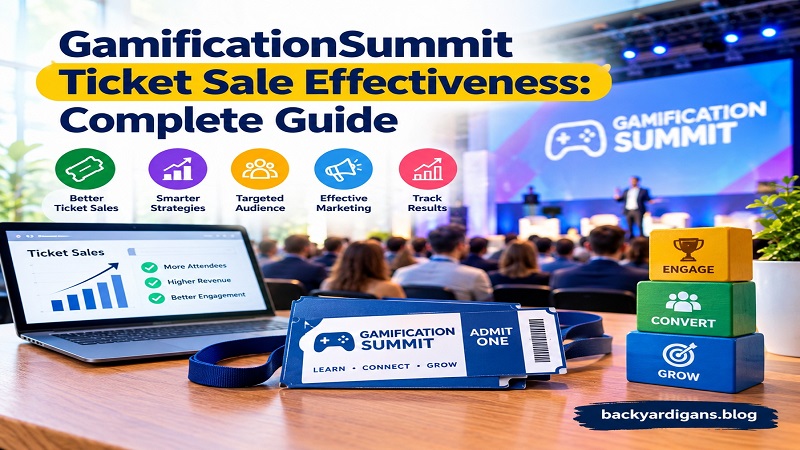
GamificationSummit ticket sale effectiveness directly represents how efficiently an event organization converts target web traffic into paid registrants using behavioral psychology. Maximizing your GamificationSummit ticket sale effectiveness ensures reliable revenue generation and optimized promotional workflows. To improve your overall GamificationSummit ticket sale effectiveness, organizers must look beyond gross attendance volume. Instead, evaluating your GamificationSummit ticket sale effectiveness requires tracking specific registration conversion percentages alongside customer acquisition costs. This comprehensive guide outlines the precise methodologies, pricing architectures, and data analytics required to audit, manage, and scale your structural GamificationSummit ticket sale effectiveness across the entire digital event promotional lifecycle.
What Is GamificationSummit Ticket Sale Effectiveness?
GamificationSummit ticket sale effectiveness is the definitive measure of how successfully an event’s promotional campaigns and conversion funnels convince target audience members to purchase registration passes.
Organizers must separate gross tickets sold from true sales effectiveness. Gross ticket volume is a simple quantity metric that fails to consider organizational efficiency or profit margins. Sales effectiveness analyzes the relationship between the resources spent and the financial results generated across the registration funnel. Relying on a single metric creates structural blind spots. For instance, high ticket volume driven by unsustainable marketing expenses can easily result in a net financial loss. True effectiveness requires evaluating several core transactional variables together:
- Ticket Conversion Rate: The percentage of unique landing page visitors who complete a registration transaction.
- Revenue Generated: Total gross monetary volume accumulated from registration fees, add-ons, and workshops.
- Average Order Value (AOV): The average amount of money spent by an attendee during a single checkout transaction.
- Customer Acquisition Cost (CAC): The total financial investment in marketing, advertising, and tooling required to acquire a single paying attendee.
- Buyer Engagement: The depth of interaction an attendee has with the event’s digital touchpoints before making a purchase.
Core Ticket Sales Metrics Framework
To evaluate these variables accurately, organizers track a standardized set of key performance metrics across the entire campaign lifecycle:
| Tracked Metric | Functional Definition | Primary Analytical Purpose |
| Conversion Rate | Percentage of page visitors completing a ticket purchase. | Measures landing page persuasiveness and technical stability. |
| Gross Revenue | Total financial volume from all completed ticket sales. | Tracks absolute financial growth against structural event overhead. |
| Average Order Value | Total revenue divided by the number of completed transactions. | Evaluates effectiveness of ticket bundles and premium VIP add-ons. |
| Customer Acquisition Cost | Total promotional spend divided by number of tickets sold. | Determines the long-term fiscal efficiency of marketing campaigns. |
| Buyer Engagement | Click-through rates, social shares, and interactive interactions. | Indicates baseline brand affinity and word-of-mouth momentum. |
How Does Gamification Improve Ticket Sales?
Gamification improves event ticket sales by integrating game-design elements and behavioral psychology into the purchasing lifecycle to transform passive buyers into active participants.
Traditional event marketing relies on repetitive promotional emails that cause ad fatigue and lower open rates. Gamification marketing introduces interactive elements that reward engagement, driving higher conversion rates and early transaction commitments. Implementing these mechanics directly influences standard buyer behaviors:
- Points Systems: Awarding digital points to users who interact with summit content, watch speaker previews, or complete profiles, which can later be redeemed for registration discounts.
- Tiered Rewards: Structuring registration rewards so that early purchasers unlock exclusive virtual badges, VIP lounge entries, or specialized session tracks.
- Milestone Challenges: Challenging the professional community to unlock aggregate tier discounts once specific registration volume thresholds are crossed globally.
- Interactive Leaderboards: Displaying real-time rankings of corporate teams, academic groups, or individual influencers who have referred the highest number of new summit attendees.
- Digital Badges: Supplying immediate, visually appealing social badges upon ticket confirmation to encourage attendees to share their upcoming attendance across professional networks.
- Viral Referral Systems: Integrating trackable links into the post-purchase screen that drop ticket prices for both the original buyer and the new registrant when a conversion occurs.
- Pre-Event Interactive Campaigns: Using quizzes, knowledge assessments, or skill challenges related to the summit’s core themes to capture qualified leads and present customized ticket options.
How to Identify the Target Gamification Summit Audience
Identifying the target Gamification Summit audience requires categorizing potential attendees by their functional business roles, operational pain points, and specific educational needs.
Vague, broad event promotion dilutes your core marketing message and lowers conversion rates. Tailoring your copy to specific professional verticals ensures your messaging addresses the unique structural challenges each audience segment faces daily.
Audience Segmentation and Core Ticketing Messages
The following framework aligns specific audience groups with their core interests and corresponding ticket value propositions:
| Audience Segment | Core Professional Interest | Optimized Ticket Value Proposition |
| Gamification Professionals | Advanced behavioral frameworks, mechanics, and industry benchmarks. | “Access cutting-edge peer case studies and validate your advanced methodology.” |
| Enterprise Marketers | Customer retention, referral optimization, and campaign activation. | “Discover proven mechanics to scale user acquisition and drop digital CAC.” |
| Product Managers | App onboarding, feature adoption, and long-term user engagement. | “Build loop frameworks that increase daily active users and product stickiness.” |
| UX/UI Professionals | Intuitive design interfaces, behavioral feedback loops, and player journeys. | “Master the intersection of visual design and psychological motivation.” |
| Game Designers | Core loops, monetization, narrative arcs, and balancing. | “Translate deep system designs into enterprise and educational applications.” |
| HR & L&D Leaders | Employee retention, internal compliance training, and remote onboarding. | “Deploy workplace strategies that boost internal training completion rates.” |
| Educators & Trainers | Classroom engagement, grading mechanics, and student motivation. | “Incorporate scalable interactive tools to improve student learning outcomes.” |
Which Ticket Pricing Strategies Can Increase Sales?
Ticket pricing strategies increase total sales by matching different price points with the perceived value, purchasing timelines, and budget constraints of your target audience segments.
Event Ticket Pricing Strategy Matrix
The following matrix summarizes these approaches to help you balance your event pricing strategy:
| Pricing Strategy | Primary Behavioral Objective | Operational Advantage | Key Risk or Limitation |
| Early-Bird Pricing | Accelerates early revenue and tracking data. | Secures cash flow; validates messaging early. | Leaves early margin on the table. |
| Premium/VIP Passes | Maximizes overall event profit margins. | Elevates AOV; attracts corporate decision-makers. | High logistical fulfillment and planning costs. |
| Group Discounts | Secures large corporate attendance. | Massive ticket volume jumps; lower overall CAC. | Dilutes standard individual profit margins. |
| Bundle Offers | Maximizes return on digital event assets. | Highly clear value communication for buyers. | Can complicate the selection stage of the funnel. |
How Do Scarcity and Urgency Affect Ticket Purchases?
Scarcity and urgency influence ticket purchases by leveraging real, time-sensitive limitations that encourage buyers to act immediately rather than delaying their decision.
When potential attendees believe tickets are always available at the same price, they naturally delay registration. This delay often leads to forgotten checkouts or scheduling conflicts. However, organizers must carefully distinguish real scarcity from artificial urgency. Misleading tactics—such as fake countdown timers that reset upon page refresh—destroy brand trust and damage professional credibility. Genuine scarcity leverages accurate structural boundaries:
- Early-Bird Deadlines: Setting a clear date and time when promotional ticket pricing ends, which encourages prompt commitments from price-sensitive audience segments.
- Limited Ticket Quantities: Capping the total number of tickets available at a specific price point to create clear competition among buyers.
- Countdown Campaigns: Using dynamic, accurate timers on the landing page during the final 48 hours before a price increase to remind users of the upcoming deadline.
- Workshop Capacity Limits: Highlighting hard structural caps on interactive masterclasses or hands-on breakout rooms caused by physical space or virtual platform constraints.
- Hard Registration Cutoffs: Specifying the final date for catering or badging lock-ins to create a natural, unbending close to all standard ticket sales.
- Transparent Availability Messaging: Displaying live inventory statements to provide clear, context-driven validation of current ticket demand.
Which Marketing Channels Can Drive GamificationSummit Ticket Sales?
Marketing channels drive GamificationSummit ticket sales by acting as the primary ways to discover, educate, and retarget potential attendees throughout the registration lifecycle.
Relying on a single promotional channel exposes an event to sudden algorithm changes and high advertising costs. A resilient ticket sales strategy uses an omnichannel approach. This system guides leads from initial awareness to final checkout across multiple touchpoints.
Marketing Channels, Purposes, and Core Performance KPIs
To balance your marketing mix, monitor the specific purpose and unique success metrics of each channel:
| Marketing Channel | Strategic Purpose | Core Performance KPIs |
| Email Marketing | Nurtures existing leads, shares agendas, and announces deadlines. | Open Rate, Click-Through Rate, Ticket Conversion Rate. |
| Social Media | Builds brand awareness, highlights speakers, and drives community reach. | Share Velocity, Engagement Rate, Click-Through Volume. |
| Search Marketing | Captures active searchers looking for gamification events and frameworks. | Impression Share, Organic Traffic Volume, Cost-Per-Click. |
| Paid Advertising | Targets specific professional demographics and job titles. | Cost Per Acquisition (CPA), Return On Ad Spend (ROAS). |
| Content Marketing | Establishes domain authority through case studies and whitepapers. | Time-On-Page, Download Conversions, Assisted Ticket Sales. |
| Partner Marketing | Leverages media partners and sponsors to reach new audiences. | Referral Link Volume, Sponsor-Driven Ticket Revenue. |
| Community Promotion | Engages niche groups on Slack, Discord, and LinkedIn. | Active Thread Participation, Exclusive Promo Code Redeems. |
| Retargeting Ads | Reminds users who abandoned their carts to finish checking out. | Cart Recovery Rate, Click-Through-to-Purchase Conversion. |
How Can Social Proof and Referrals Improve Ticket Sales?
Social proof and referral marketing improve ticket sales by reducing perceived financial risk and using trusted recommendations to influence buying decisions.
Professionals are naturally skeptical of generic corporate marketing claims. They place far higher value on validation from peers, industry leaders, and past attendees. Integrating systematic trust signals throughout your promotional campaign creates strong validation that directly improves your conversion rates:
- Verified Attendee Testimonials: Showcasing specific, measurable success stories from past summits that focus on concrete business returns rather than generic praise.
- Speaker Credibility Highlights: Showcasing the real-world experience, corporate backgrounds, and thought-leadership profiles of your featured presenters.
- In-Depth Case Studies: Publishing detailed breakdowns of real problems solved during previous summit workshops to demonstrate the practical value of attending.
- Tiered Referral Programs: Rewarding current ticket holders with cash back, gift cards, or exclusive upgrades when their colleagues or professional contacts register.
- Speaker and Partner Toolkits: Supplying customized social media graphics, pre-written copy, and unique referral codes to speakers, sponsors, and media partners.
- One-Click Social Sharing Hooks: Adding clear, automated social sharing buttons directly to the post-purchase confirmation page so new registrants can quickly share their attendance.
- Community Recommendations: Encouraging active community discussions and organic peer-to-peer endorsements across platforms like LinkedIn, Reddit, and specialized industry Slack channels.
How Should the Ticket Website and Checkout Process Be Optimized?
Optimizing the website and checkout process requires removing all technical and cognitive friction from the buyer’s journey to turn interested visitors into confirmed attendees.
A beautiful marketing campaign matters little if a confusing checkout process causes users to drop out at the final step. Minimizing required form fields, ensuring perfect mobile responsiveness, and providing complete cost transparency before the final payment screen can significantly reduce cart abandonment.
Checkout Problems, Consequences, and Structural Improvements
The following matrix highlights common friction points in the checkout process and lists actionable design fixes to resolve them:
| Identified Checkout Problem | Immediate Operational Consequence | Actionable Design Optimization |
| Vague Ticket Descriptions | Confuses users about what is included, causing them to delay purchasing. | Write clear, bulleted lists of details for every ticket tier. |
| Hidden Fees & Costs | Causes sudden transaction abandonment on the final payment page. | Maintain total pricing transparency right from the start. |
| Complicated Registration Forms | Annoys buyers and lowers completion rates, especially on mobile devices. | Keep forms simple; collect non-critical details after purchase. |
| Rigid Payment Gateways | Prevents transactions from international corporate buyers. | Offer flexible options like credit cards, digital wallets, and invoicing. |
| Poor Error Handling | Clears the entire form during an error, forcing users to start over. | Highlight specific invalid fields clearly without deleting entered data. |
| No Clear Post-Purchase Path | Leaves attendees confused about whether their transaction succeeded. | Send automated confirmation emails and show clear next steps. |
Which Metrics Measure GamificationSummit Ticket Sale Effectiveness?
Measuring GamificationSummit ticket sale effectiveness requires tracking a combination of absolute volumes, conversion efficiencies, and cost metrics to get an accurate view of overall event health.
Relying solely on gross ticket sales can mask serious underlying issues, such as high customer acquisition costs or severe drop-offs on your checkout pages. To evaluate your performance accurately, organizers must track a balanced set of key performance indicators together:
- Total Tickets Sold: The absolute number of registrations across all tiers, tracking total event scale and room capacity limits.
- Conversion Rate: The percentage of page visitors who complete registration, evaluating your website’s layout and content clarity.
- Gross Revenue: Total revenue from tickets, add-ons, and workshops to measure financial health against your event’s budget.
- Average Order Value: The average amount spent per checkout transaction, showing the effectiveness of your bundles and VIP upgrades.
- Customer Acquisition Cost: The marketing spend required to win one attendee, evaluating the sustainability of your paid marketing.
- Cost Per Ticket Sold: Total event expenses divided by total tickets sold to determine the true profit margin of each ticket tier.
- Cart Abandonment Rate: The percentage of users who start checkout but don’t finish, pinpointing technical problems or hidden fees on checkout pages.
- Referral Conversions: Tickets purchased using a peer referral link, measuring organic word-of-mouth and viral loop success.
- Email Conversion Rate: Ticket purchases generated directly from email clicks to test your email segmenting and subject lines.
- Sales Velocity: The speed at which tickets sell over a given time, helping predict final attendance and plan marketing pushes.
- Return on Marketing Investment: Net ticket revenue divided by total marketing costs to prove the financial value and success of your campaigns.
How Can Organizers Optimize Ticket Sales With Data?
Organizers optimize ticket sales with data by analyzing how users move through the registration funnel and making continuous, evidence-based adjustments to their campaigns.
Relying on guesswork or intuition during a promotional campaign often leads to misallocated ad budgets and missed sales goals. Instead, analyzing behavioral data lets you quickly identify where users are dropping out and fix those specific issues. A structured approach to data-driven optimization includes these steps:
- Mapping the Complete Buyer Journey: Tracking how users move from their first touchpoint—like a LinkedIn post or search result—all the way to final checkout.
- Finding Conversion Bottlenecks: Spotting sharp traffic drops on specific pages, such as a high bounce rate on the ticket selection screen, to fix design issues.
- Monitoring Real-Time Sales Velocity: Reviewing daily and weekly sales trends to spot slow periods and trigger well-timed promotions before deadlines pass.
- Comparing Performance Across Ticket Tiers: Tracking which packages sell out fast and which stall to adjust inventory limits or rewrite descriptions.
- Running Structured A/B Tests: Continuously testing different headlines, call-to-action buttons, pricing layouts, and hero images to identify the best variations.
- Measuring Channel ROI: Evaluating the cost-per-acquisition across all platforms to stop low-performing ads and scale high-performing campaigns.
- Reviewing Referral Program Impact: Analyzing referral metrics to see which incentives encourage the most word-of-mouth shares.
- Fixing Checkout Abandonment Issues: Reviewing form analytics to find out why users leave during checkout, allowing you to remove confusing fields or add preferred payment methods.
Frequently Asked Questions
What is GamificationSummit ticket sale effectiveness?
GamificationSummit ticket sale effectiveness is the metric framework used to evaluate how efficiently an event organization converts target audience members into registered ticket holders. It analyzes the relationship between marketing costs, landing page conversions, and overall event revenue rather than just tracking gross ticket volume.
How does gamification increase event ticket sales?
Gamification increases event ticket sales by adding interactive elements like point scoring, milestone challenges, and tiered rewards directly into the promotional campaign and registration funnel. These mechanics turn a simple transaction into an engaging experience, which helps drive early ticket purchases and higher conversion rates.
What is an effective strategy for selling gamification summit tickets?
An effective strategy requires combining an omnichannel marketing plan, targeted messaging for specific audience segments, and a multi-tiered pricing model. Organizers can then use authentic urgency drivers and peer referral loops to systematically build sales momentum.
How can early-bird tickets affect summit sales?
Early-bird tickets accelerate early revenue generation, build social proof, and provide essential sales velocity data. This early information helps organizers evaluate their marketing message and forecast final event attendance more accurately.
How can event organizers measure ticket sales effectiveness?
Organizers measure effectiveness by tracking a balanced set of key performance indicators, including conversion rates, customer acquisition costs, average order value, and cart abandonment rates. Looking at these metrics together prevents over-relying on total ticket volume alone.
What gamification techniques can be used to promote event tickets?
Effective techniques include viral referral leaderboards, interactive quizzes that recommend personalized ticket packages, profile completeness points, and digital social sharing badges. These tools encourage attendees to naturally promote the event to their own professional networks.
Conclusion
Maximizing GamificationSummit ticket sale effectiveness requires a coordinated strategy that optimizes every step of the buyer’s journey. By focusing on clear audience segmentation, implementing structured pricing tiers, leveraging authentic urgency, and removing friction from the checkout process, organizers can significantly improve their conversion rates. Ultimately, success relies on using data-driven insights to monitor key performance metrics, optimize marketing spend, and continually refine your strategy based on real buyer behavior.